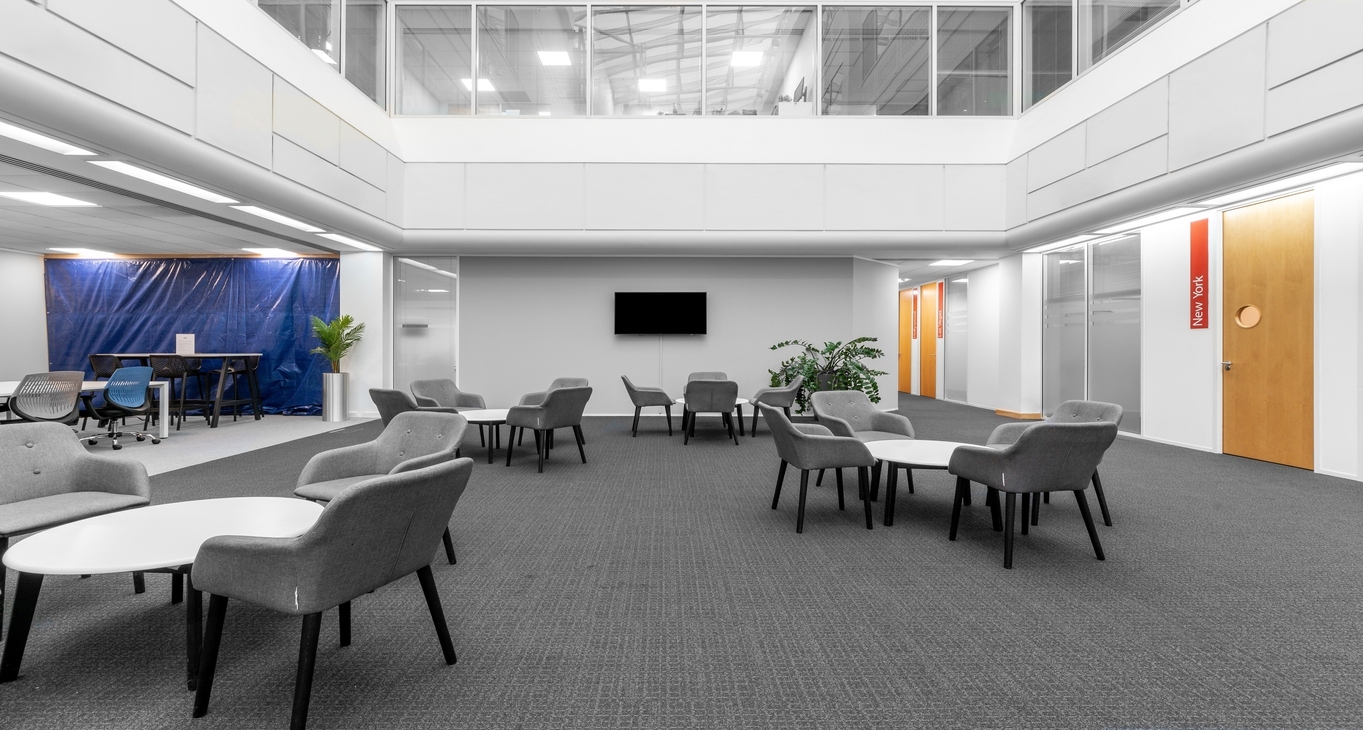
Temporary Workspace in the UK: Renting by the Day or Month
Temporary workspace is anything you take for days or months rather than years: a day pass, a rolling monthly desk, or a short licence on a private room. Across the UK this catalogue lists 502 buildings with desks from £118 a month and 548 buildings with rooms from £145 a month.
What counts as temporary workspace?
Three shapes, all available across the 553 UK buildings here. In the UK flexible market, "temporary" describes the commitment, not the building. The same serviced floor in Leeds or Reading sells a day pass, a rolling month and a two-year licence; what changes is the notice period and the price per month, not the desk. That is the opposite of a conventional lease, where a short term is a different and usually worse product.
Three shapes cover almost every temporary UK requirement, and they suit genuinely different situations rather than different budgets.
How short can a term actually be?
| Shape | Typical term | Suits |
|---|---|---|
| Day pass | A single day | Travel, occasional days out of the house |
| Rolling desk membership | One month, rolling | A project, a trial, an uncertain quarter |
| Short room licence | 3–12 months | A team between premises, an overflow, a UK market test |
Day rates across the UK run roughly £15–45, with observed rates from £22.80 to £106.80 and a median of £42 across 399 spaces (Wezoo, August 2026). Central London sits at the top of that range and beyond it.
What does short notice cost you?
The premium sits in the term, not in a line item, and it is why the same room can be quoted twice against the £145 entry rate. Flexibility in a UK building is priced, and the mechanism is usually the term rather than a separate premium: the same room is quoted lower on twelve months than on three. Expect the shortest terms to carry the highest monthly figure, and expect a deposit — commonly one to two months — regardless of how short the term is.
What flexibility buys back is the thing a lease cannot. A rolling monthly desk in a UK centre can be stopped with a month's notice; a five-year lease on the same floor cannot, and the cost of being wrong about headcount is the whole remaining term.
Which format fits which situation?
- A project with an end date. A rolling desk membership, one per person, stopped when the project stops. Listed from £118 a month across 502 UK buildings.
- A team between premises. A short room licence in a serviced building — 2,898 rooms are listed in 548 buildings from £145 a month, and the median listed room is 65 m².
- Testing a new UK city. A desk or small room plus a registered address in the same building; business addresses start at £52 a month in 465 buildings.
- Occasional days only. Day passes, not a membership — below roughly eight days a month, passes are cheaper at the £42 UK median.
What to check in a short-term agreement
Six clauses decide how temporary a UK agreement really is, whichever of the 548 buildings it is signed in:
- Notice period — the number that actually governs how temporary this is, and often longer than the term implies
- Deposit, and the conditions for getting it back
- Whether the rate is inclusive of VAT, and what happens to it if you extend
- Whether the term auto-renews, and on what notice
- What is included: business rates, utilities, cleaning and internet normally sit inside a UK flexible rate
- Whether you can scale up mid-term without restarting the agreement
Where to start
Temporary arrangements exist in all 173 UK towns and cities in this catalogue, across 553 buildings from 20 operators. Browse coworking desks for the shortest commitments, serviced offices for rooms, or every UK location at once. Enquiring costs the tenant nothing — operators and building owners pay the fee.
Sources
- Wezoo — Coworking Space Cost UK (7 August 2026): day-rate range and median across 399 UK spaces
- Listing counts, room sizes and entry rates: the Coworkings.uk catalogue, 553 buildings, rebuilt with every deploy